
“Adios”
by C. Terek
The Filley Flash July 1934 (Camp Filley newletter)
“We leave you tonight for our home towns,
Our duties we hope are fulfilled:
Although the parting is hurting – leaving against our will,
So we hope in the fall
To pay you a call
And renew old acquaintances again.”
I have long been aware of the Civilian Conservation Corps (CCC) and their works, but like many things that are part of my daily life, the CCC stayed on the periphery, blending into my surroundings. As I hiked my favorite trails I would give a passing glance at the various features, whether they be tower ruins, a dam, or steps, and think “CCC”, but I never delved much deeper as to what that truly meant.
That changed recently when I did a loop hike in Madison, CT in early 2023 and passed through Camp Hadley. In 2013, high school sophomore Sam Wilson became intrigued by some overgrown ruins he spotted in the woods while out walking. This initial interest evolved into a student-led project (in cooperation with the Madison Land Conservation Trust and the Department of Energy and Environmental Protection – DEEP) to study the history of the CCC’s Camp Hadley, clear the area and create signboards and markers to explain the visible ruins. This newly redone trail was inaugurated in 2015 as the Conservation Corps Camp Hadley Trail. As I paused to read the signboards and examine the ruins, I became interested in learning more about the history of the CCC in Connecticut.
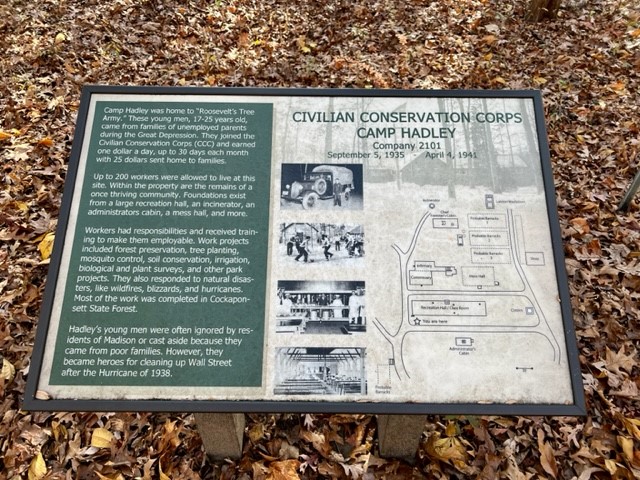
I started in my favorite place – the Killingworth Library – and found some excellent resources (see my bibliography for details). I highly recommend Martin Podskoch’s 2016 book: Connecticut Civilian Conservation Corps Camps: History, Memories and Legacy of the CCC. Podskoch has done our state a tremendous service in helping to keep our CCC legacy alive. He had previously written a book about the history of the CCC in the Adirondacks, so when he moved to Connecticut in 2005 in his retirement from teaching, a book about the CCC in his new home seemed like a logical next step. He began compiling research for his book, including finding as many stories as he could from the last remaining CCC enrollees or their descendants. Podskoch has given presentations all across the state, and is involved with the CCC Museum in Stafford, CT, which is in the former Administration Building of Camp Conner and is open Saturdays and Sundays 10:00am to 3:00pm from Memorial Day Weekend to Columbus Day Weekend. I was fortunate to meet Marty in person at a CCC presentation he gave in November at the Middlefield Historical Society. He is an entertaining and dynamic speaker and at 80 years old isn’t showing any signs of slowing down – his current project is documenting all the CCC camps in Vermont. Check the museum website events page (link in bibliography) for his presentation schedule.
While the hard work of these millions of young men made a lasting impact on our country’s infrastructure, the CCC program in turn made a lasting impact on these young men’s lives in invaluable ways. As Podskoch states in his preface: “….these young men developed a sense of worth…Once in the CCC they felt important. They learned how to take orders, developed a love of nature, and learned a trade, all of which gave them a sense of self-worth. They knew they were helping their country and their family.”
2023 marks the 90th anniversary of the creation of the CCC. Winter is a good time for walking the grounds of the old camps with fewer worries about ticks and brush, and to more easily locate some of the ruins.
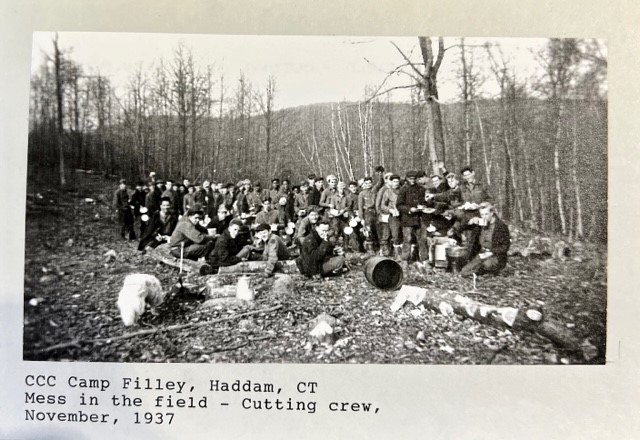


Photos courtesy of the Haddam Historical Society
First, a few CCC facts:
- The CCC was the brainchild of President Franklin D. Roosevelt and was created as a way to put to work poor, unemployed single men between the ages of 18-25 during the Great Depression. Each worker earned $30 a month, $25 of which was sent home to his family. If an enrollee got married he could complete his term but not re-enlist when his six month term was over. Maximum participation was two years.
- In its ten years of operation (1933 to 1942) the CCC put to work over 3 million men in more than 4,000 camps in all 48 states at the time plus Alaska Hawaii, Puerto Rico and the Virgin Islands.
- No women were allowed to enlist.
- In most of the US separate companies were established for black enrollees with 250,000 participating in 150 CCC companies. (All of New England had integrated camps).
- A 1934 Act of Congress established a CCC Indian Division employing Native Americans in 72 work camps in Indian Reservations.
- More than 22,000 men served in 21 camps across CT). The work focus in Connecticut was primarily forest management, insect control, and the development of recreational facilities. The CCC boys also were instrumental in cleanup after the flood of 1936 and the Great Hurricane of 1938.
NOTE: Many of the trails described below are on lands that allow hunting. It is recommended to wear fluorescent orange during hunting season. See the current CT Hunting & Trapping Guide for more information HERE
CAMP HADLEY, Madison, CT.
I visited again in mid-November and chose a 3.25 mile loop hike starting at Camp Hadley. There is a parking pullout on Warpas Road at the trailhead. After tromping through the leaves to view all the camp ruins I continued in a counter-clockwise direction, following the blue trail north past Lost Pond and then turned left, crossing Warpas Road by the church, continuing onto a section of the Double Loop Trail. I continued south into the Lowry Woods Community Forest before popping back out on Warpas Road and returning to my car. The Lowry Woods Trail Map displayed on the kiosk is newer and more complete than the one on the website (see picture below). Click HERE for a trail map of Camp Hadley and the Double Loop Trail. If the weather is cold, I recommend doing this hike in reverse so that you finish with the visit to the CCC ruins after you are warmed up from an invigorating walk. You can extend your hike by adding a loop of the Jefferson Park trail, or shorten it by just visiting the Camp Hadley ruins. All the trails are marked with blue blazes and round blue metal hiker discs. At the Camp Hadley ruins there are also red trail markers that I found confusing, as they are not shown on the trail map. Along the trail there are kiosks that show your current location. There are numerous turns, and since every trail is blazed blue it is important to pay attention to which turns you make. Please note that bow hunting is allowed on most of these properties so it is recommended to wear fluorescent orange during hunting season.
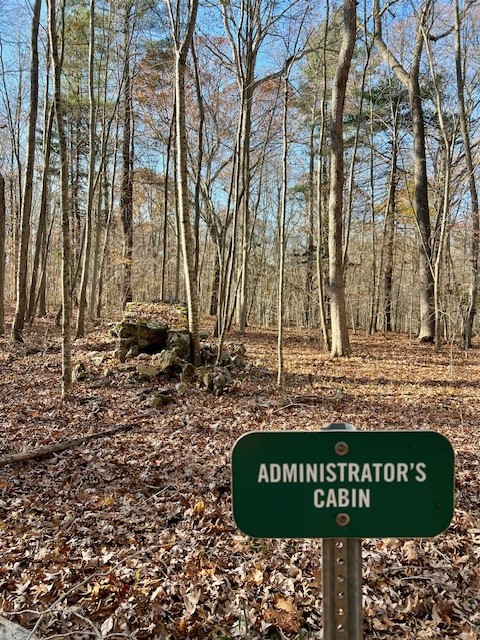

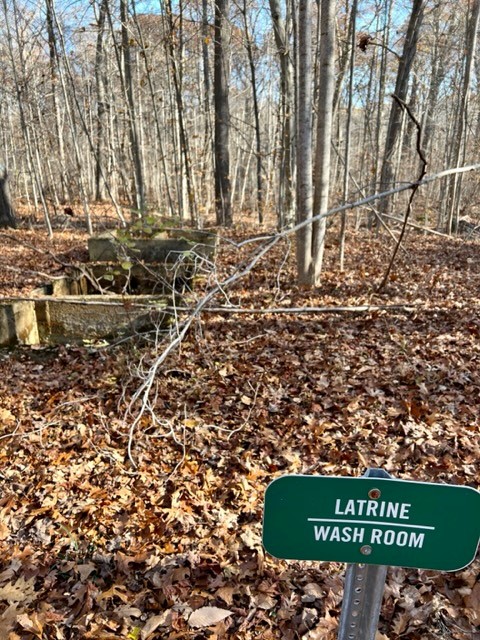

From left to right: Ruins of Administrator’s Cabin; Chimney of the Chief Forester’s Cabin; Latrine ruins; kiosk with updated Lowry Woods Trail Map
CHATFIELD HOLLOW STATE PARK, Killingworth, CT
Killingworth was home to Connecticut’s first CCC camp, Camp Roosevelt, named for the President who initiated the program. Workers from Camp Roosevelt initially worked on road improvement projects at Hammonasset Beach. In 1934, the most iconic and impactful project for our area began – construction of the dam along Chatfield Hollow Brook creating the 7-acre Schreeder Pond, a popular swimming destination for state residents. Along with the dam, CCC workers constructed the Oak Lodge which was used as the Mess Hall. It is now on the National Register of Historic Places and serves as a Nature Center. I read a recent article about Naturalist Wray Williams who works at the Nature Center on the weekends (see article link in the Bibliography). The article said he hoped to stretch his hours into October, so I was pleasantly surprised when I stopped in the Sunday after Thanksgiving and had the chance to tour the interior of the lodge and talk with Williams. He wasn’t sure how far into the winter season the Lodge will be open, but if you are in the area it’s worth checking. Even if you can’t enter the Lodge, on the exterior you can view a statue honoring CCC workers that was dedicated in May of 2019. According to an article in the New Haven Register, two former CCC enrollees (aged 102 and 96 in 2019) were in attendance at the dedication ceremony. Other legacy contributions of the Camp Roosevelt workers were rebuilding the old water wheel and mill pond, and the construction of trails in the park running from Route 80 to the mill pond.
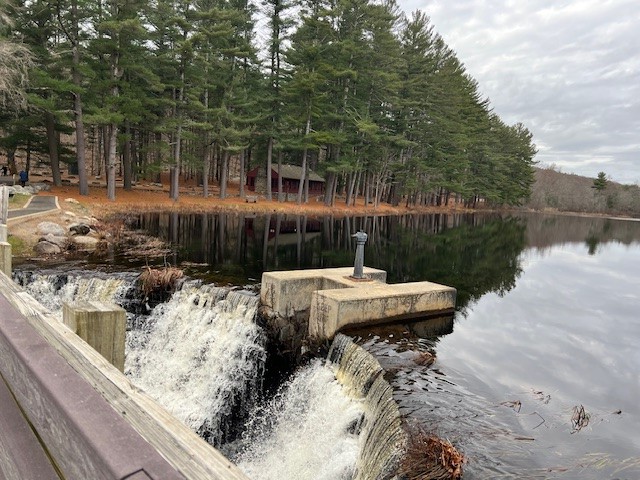
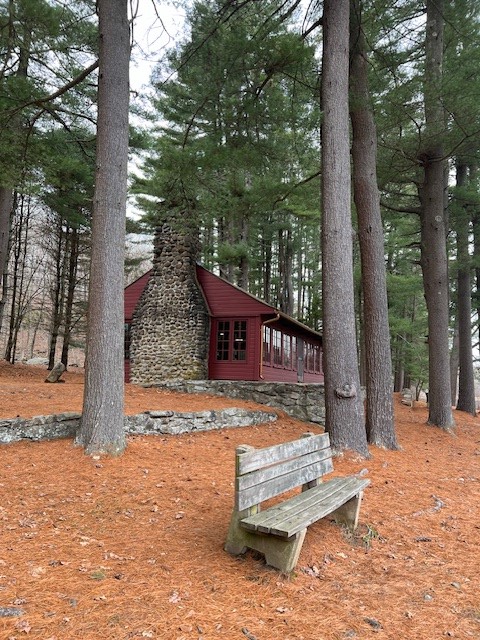

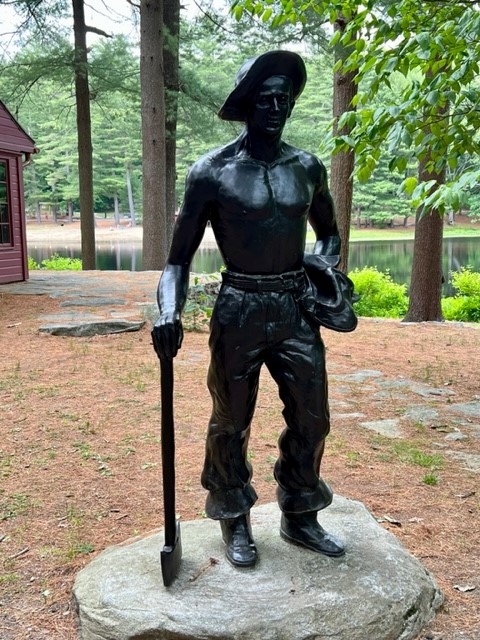
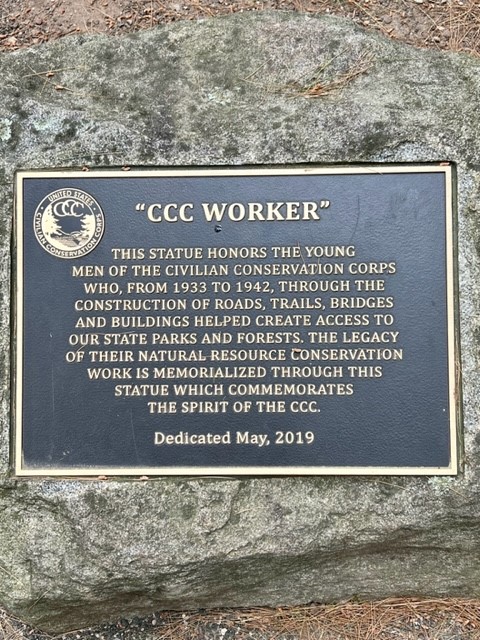
From left to right: Oak Lodge Nature Center exterior; Oak Lodge interior; Statue commemorating the CCC workers; Dedication plaque
WITCHES HOLLOW NATURE TRAIL. ½ mile.
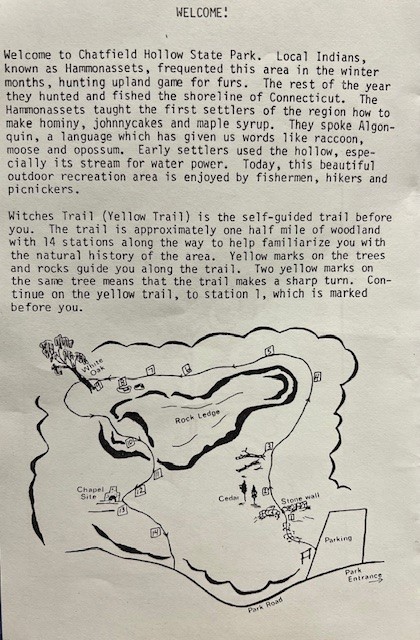
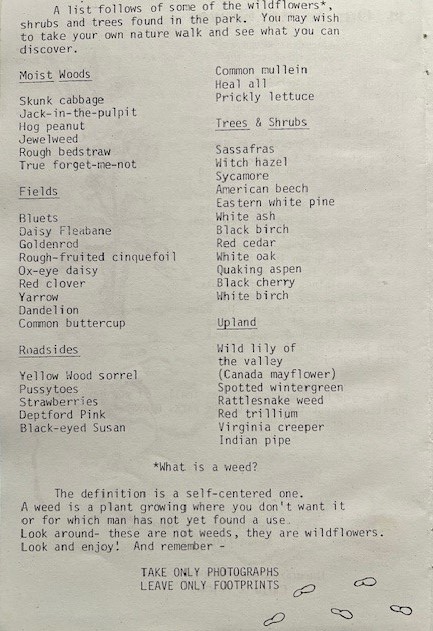
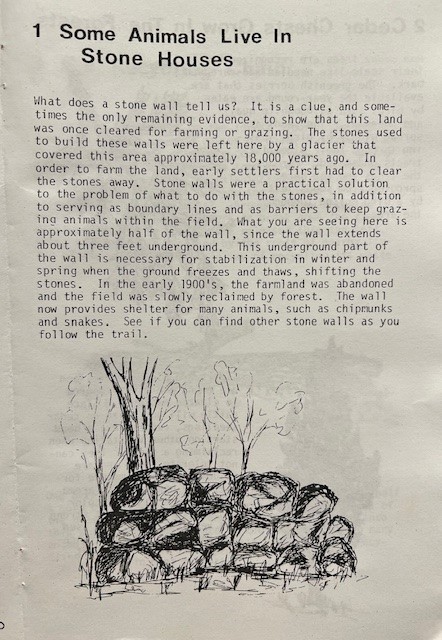
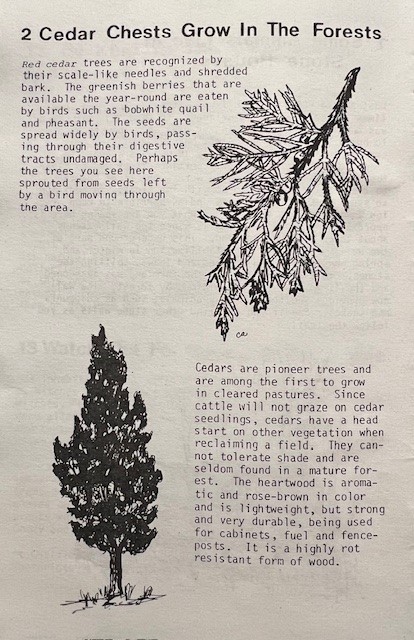
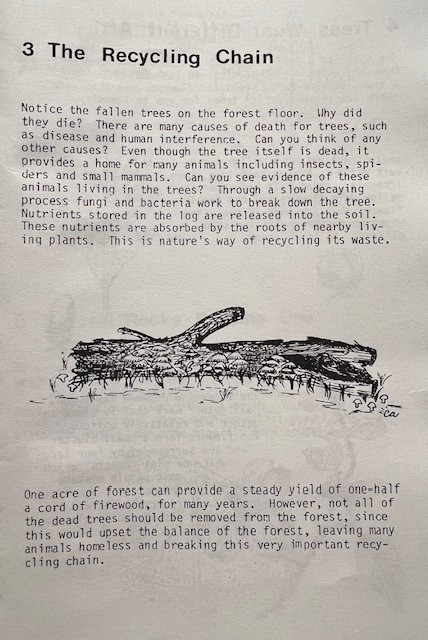
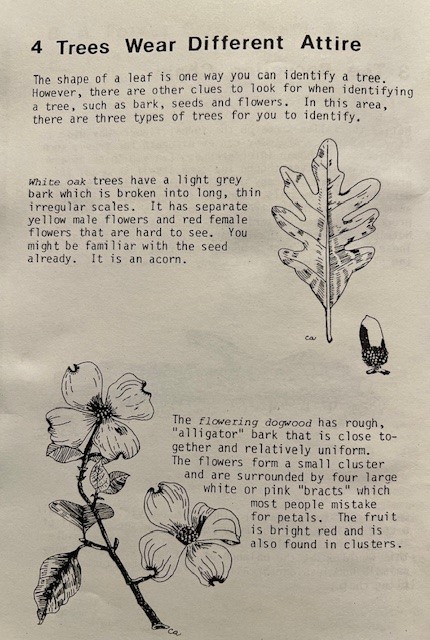
This yellow-blazed trail is one of my favorites. The trail starts on the right side of the entrance road opposite the picnic pavilion and comes out near Schreeder Pond. It is just under ½ mile, and offers a lovely route through picturesque rock formations with the added bonus of a mysterious chimney. Still visible along the trail are 14 numbered timber posts. I recalled a kiosk with maps at one point in time. In Podskoch’s book I was thrilled to see a photograph of the old kiosk and a carved wooden map showing the 14 reference points. I noticed that local resident and DEEP employee Andy Annino had provided Podskoch with information about the stone chimney which was built by the CCC and purportedly part of an open-air chapel . I contacted Andy and he was able to track down a copy of the booklet for me! I share photos of the booklet pages after the bibliography at the end of this post. I plan to hike this trail again in the near future with booklet in hand to see if I can identify all the listed features these many years later. Perhaps I will see you there!


From left to right: The Trailhead; a section of stone steps; station 5 – an example of metamorphic rock; station 13 – the mysterious “chapel” chimney
For a trail map of Chatfield Hollow State Park click HERE
NOTE: Hunting is permitted in the Cockaponset State Forest section of Chatfield Hollow. Please plan accordingly and wear orange during hunting season if you plan to hike those trails.
COCKAPONSET STATE FOREST, Haddam and Chester, CT.
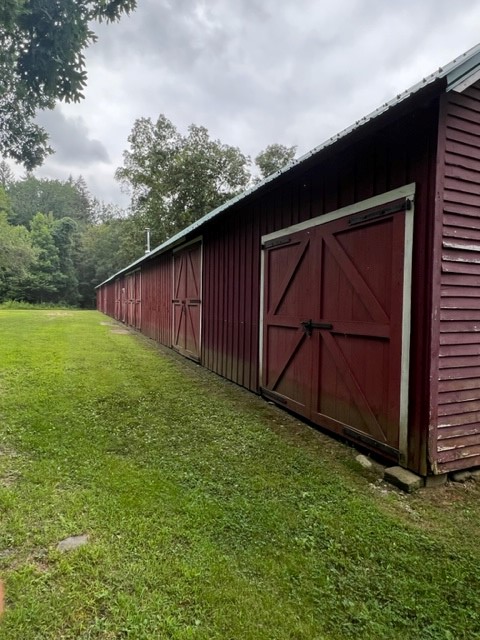
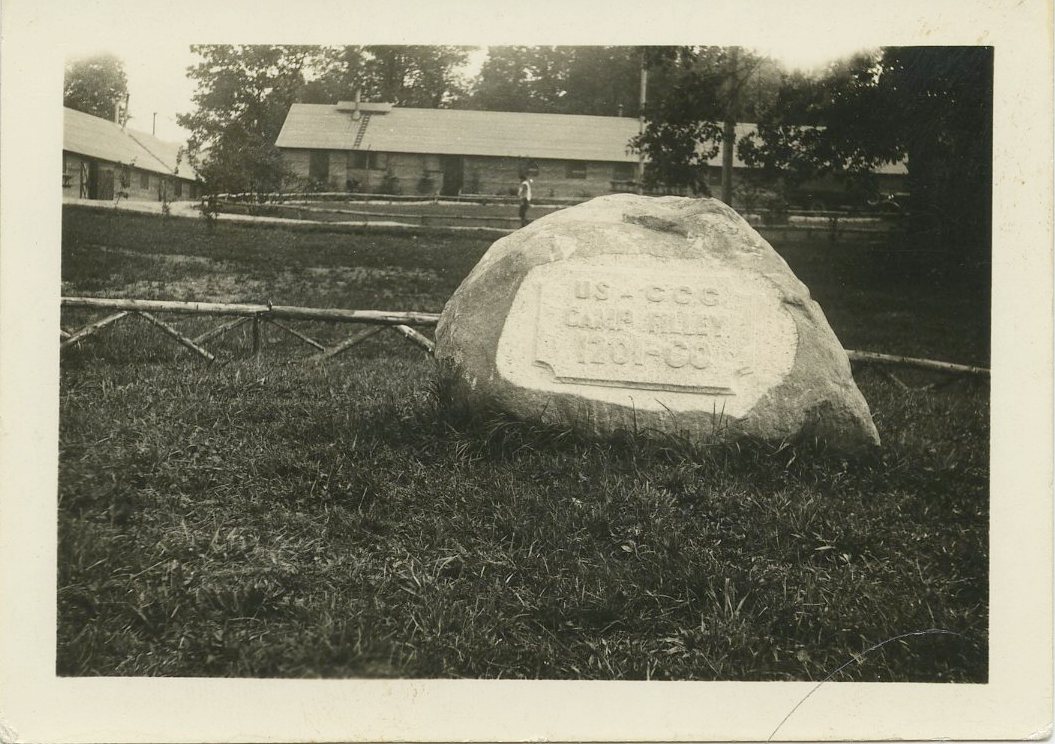
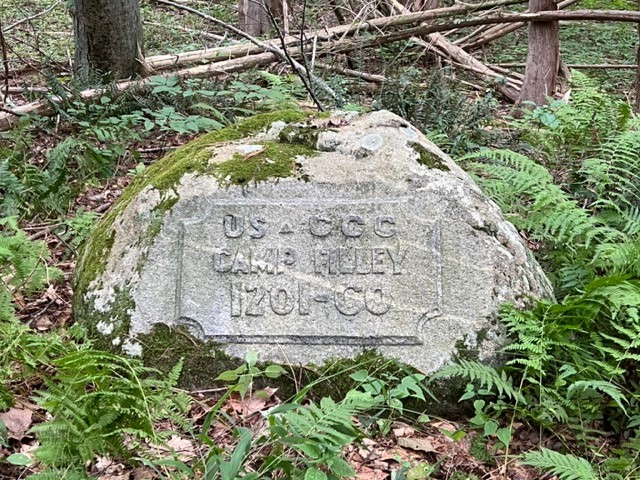
In Haddam, the CCC camp, Camp Filley, was on the corner of Filley and Turkey Hill Roads. The only remaining structure is the state-owned “Cockponset Lumber Barn” which is listed on the State Register of Historic Places. The ruins of the camp behind the barn have been designated a State archaeological preserve and access to the public is limited. Podskoch’s book includes a hand-drawn map and an aerial photo of the camp which are helpful in envisioning what the buildings used to look like. I was fortunate to get a personal tour of the old camp from my fellow Cockaponset Trail Manager and mentor, Rob Butterworth. The stone with the Camp Filley name and company number is still there, although it has been overtaken by the woods. It would be wonderful to see these ruins turned into an accessible history trail similar to the work done in Madison at Camp Hadley.


As part of their work, the Camp Filley enrollees built several trails in Cockaponset State Forest. According to Kornel Bailey in his 1982 paper entitled History of the Hiking Trails in Cockaponset Forest “the trail along the west shore of Pattaconk Reservoir was finished all the way to the picnic area on Beaver Meadow Road before May 1940.” Bailey was hired by the CCC at Camp Roosevelt as a LEM (Local Experienced Man) taking on the role of assistant leader in some forestry operations. This section of trail is now maintained by the Connecticut Forest and Park Association as part of the state’s Blue-Blazed Trails System. For more information about CFPA’s mission and history click HERE. Bailey was a Trail Manager in Cockaponset for many years and his paper describes the timeline of the extensions to this original trail. In 1973 he extended the trail from Pattaconk Reservoir south to Route 148. Between 1978 and 1980 he worked on several alternate trails to create loop hikes. These became known as the Wildwood Trail and the South Pattaconk Trail and were originally blazed blue with a red dot (now simply blue with a red square). Hiking the entire loop from Beaver Meadow to Route 148 is just over 13 miles. When I did this in September of 2020 I parked at County Road which gave me the chance both to opt out of the full hike if needed and to replenish my food and snack supplies. Following are two shorter hiking suggestions.
NORTHERN BLUE – BLUE/RED LOOP. 4 miles (approximately).
This northern loop between Jericho Road and Beaver Meadow Road is my favorite for showcasing the CCC’s trail work. If you are unfamiliar with Cockaponset State Forest I suggest you refer to the trail map HERE as you read my descriptions below, especially for the different parking suggestions.
To avoid the gravel roads, there is a one to two car pullout at the northern end of Beaver Meadow Road. Another option is to enter the forest from Beaver Meadow Road onto Old Mottland Road and either park at a pullout where the blue trail crosses Jericho Road, or earlier at the corner where Old Mottland Road becomes Jericho Road. This latter option adds about 1/2 mile to the hike. A 4th option is to park on Old County Road where there is a much larger parking area and follow the blue trail north. This adds about one mile.
The following description assumes starting at the blue trail trailhead on Jericho Road and heading north in a counterclockwise direction. Almost immediately the trail splits. Take the blue trail to the right and go up the first of many stone steps built by the CCC. After about .3 miles you come to four concrete footings on the right — all that remains of an observation tower built by the CCC for recreational purposes. In some places this is referred to as an old fire tower, but that is incorrect. Continue north along a scenic ledge and you will encounter several more up and down sections with stone steps before crossing Jericho Road, and continuing on blue. At the end of this next section, before crossing Jericho Road a second time, you will pass a large vernal pool on your right. Hiking at this time of year it is hard to imagine this seasonal pond dries up completely in summer, but it does! The final section of blue trail is not part of the original trail, which went all the way to the Odber picnic site on Beaver Meadow Road north of Route 9. Once Route 9 was built the northernmost section of trail was rerouted to its current location. After the trail crosses Beaver Brook watch for the junction with the blue/red blazed trail on the left. The first section of the blue/red Wildwood Trail winds steeply uphill to the top of the ridge and is spectacular in June when the mountain laurel is in bloom. When you reach the ridge top and start your descent you know you are almost done.

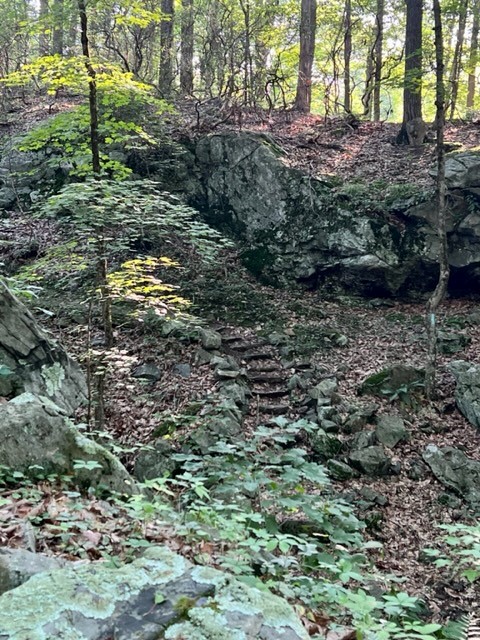

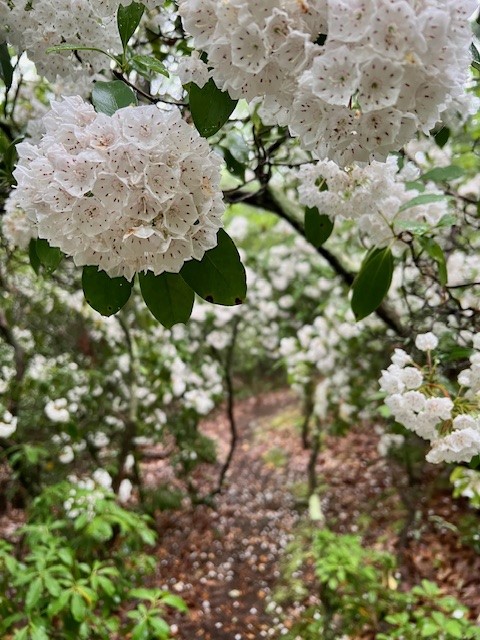
From left to right: Observation tower footing remains; stone stairs along the blue Cockaponset Trail; laurel on the Wildwood Trail
PATTACONK RESERVOIR LOOP. 2.85 miles.
This is a generally flat hike that goes past the old Pattaconk picnic area, one of three picnic areas built by the CCC boys, and loops around the pond. There are a few roots and rocks to negotiate.
Use “Pattaconk Recreation Area” in your GPS for directions – it is off Cedar Lake Road in Chester (the new sign merely says Cockaponset- a Connecticut State Forest). Drive past the Reservoir until you see the yellow gate and park in the smaller lot on the left hand side. Walk between the boulders on the south side of the lot. You will see a yellow/green blaze. Almost immediately turn left to follow the blue trail to the yellow trail junction at a small footbridge. Cross the bridge, following the yellow blazes until you reach the entrance road. Turn right and follow the road for a short distance. Immediately after crossing a stream the yellow trail continues into the woods on your left. From the paved road to the dam visible in the distance look around for the ruins related to the old Pattaconk picnic area. On your right will be the incinerator, a building foundation that was likely an administration building, steps with an old handrail, and a well. On the left are the remains of an outdoor grill.
Continue following the yellow blazes along the eastern side of the reservoir. You will pass a camping area with tall pine trees and lean-tos. If you go on a weekend you may encounter a Boy Scout troop or other youth group. Continue on yellow around the pond until the trail merges with red/blue. Stay left, and when the trail goes over an arched footbridge continue on blue/red as it loops around the west side of the reservoir. When you reach the southern end of the reservoir you can walk out to the beach or continue straight back to the parking area by following the blue trail. While called a reservoir, it is not a drinking water supply, so swimming is allowed. According to the DEEP “Pattaconk Reservoir probably was originally constructed to provide a summer water supply for powering mills downstream.”
For a trail map showing the southern section of Cockaponset, including this trail, click HERE

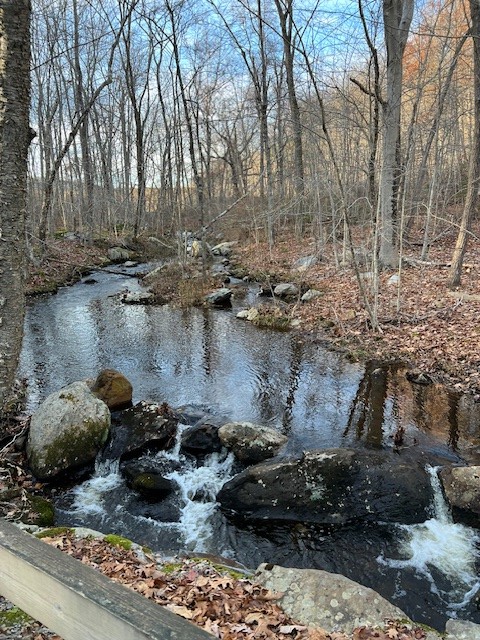
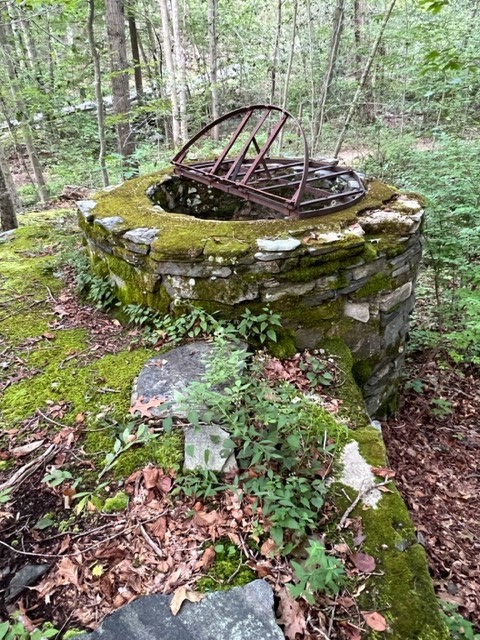
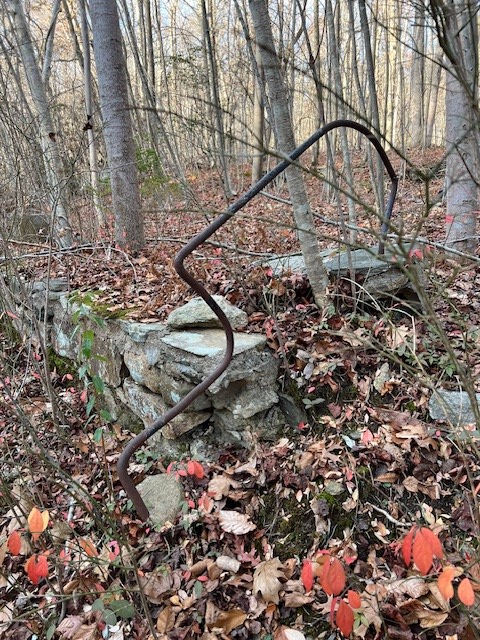
From left to right: The trailhead; Pattaconk Brook; the old picnic area incinerator; dilapidated steps and handrail
DRIVING TOUR.
If you are interested in seeing some of the CCC ruins but aren’t able to hike, here is a driving tour option. Start at Pattaconk Reservoir. Instead of taking the trail, walk along the road to the Pattaconk Picnic Area ruins described above.
Upon leaving Pattaconk Reservoir, take a left onto Cedar Lake Road. At the fork stay left. This is Filley Road which becomes a gravel road. Follow Filley Road past Turkey Hill Reservoir on your right. After a while you will pass Jericho Road on your left. After this intersection, look for a pullout on the left. From this pull-out you will be able to see the incinerator from the old Turkey Hill picnic site in the woods on your left (your view will be obscured in summer).
Continue on Filley Road. It will become a paved road. Stay to the right as you pass a few junctions and look for the red lumber barn on the right hand side just before the road dead ends at Turkey Hill Road. This is the only remaining building from the old Camp Filley. The Camp Filley ruins are in the woods behind the barn, but the area is currently closed to the public.
Turn left onto Turkey Hill Road. At the stop sign turn left again onto Beaver Meadow Road. Just before reaching Route 9 there is a parking pullout on the left side of the road. On the right side is all that remains of the Odber Picnic Area at the site of the old Odber Mill. This parcel was donated to the (then) State Forestry Division by a Mrs. William B. Odber, according to a sign at the site in the 1930’s. This picnic area once had a bridge crossing the Beaver Meadow Brook and several grill sites.
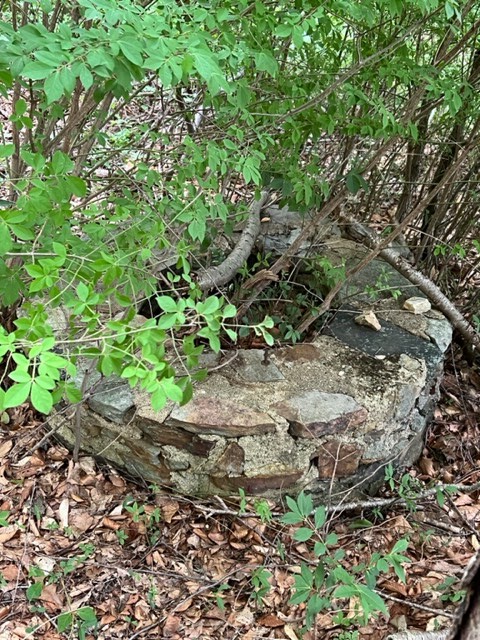


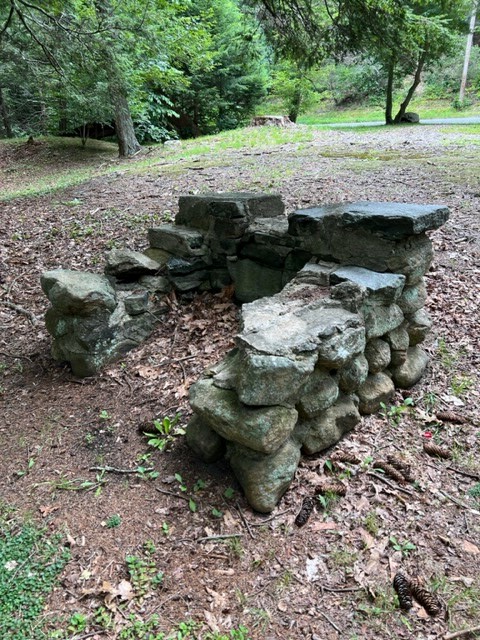
From left to right: the old well at the Pattaconk picnic area; incinerator at the old Turkey Hill picnic site; the remains of the bridge and a grill at the Odber picnic site on Beaver Meadow Road
BIBLIOGRAPHY
ONLINE RESOURCES
Website dedicated to the legacy of the CCC. The site includes information about the camps, along with photos and other memorabilia organized by state. https://ccclegacy.org/
Article about the designation of Camp Filley as a state archaeological preserve (p. 21). https://ctwoodlands.org/wp-content/uploads/2022/10/woodlands_2010_spring.pdf
2023 CT Insider Article about the History of the CCC at Chatfield Hollow https://www.ctinsider.com/shoreline/article/ct-s-chatfield-hollow-state-park-testament-ccc-18089487.php
A guide for teaching CCC history in CT classrooms, complete with additional information links https://teachitct.org/lessons/the-civilian-conservation-corps-in-connecticut/
CCC. Article about Camp Hadley excavations: https://www.archaeology.org/news/3231-150423-connecticut-ccc-camp
CCC Museum website https://martinpodskoch.com/ccc-museum/
CCC Museum Brochure https://portal.ct.gov/-/media/DEEP/stateparks/forests/shenipsitbrochure2015pdf.pdf
NPR podcast “Where We Live” interview with Marty Podskoch and a 102 year old “CCC Boy” https://www.ctpublic.org/education/2017-07-18/the-civilian-conservation-corps-lasting-impact-on-connecticut
Shoreline Times article about Wray Williams, Naturalist at the Oak Lodge in Chatfield Hollow State Park, Sept 2023 https://www.zip06.com/living/20230906/the-more-you-know-the-less-you-fear/
AVAILABLE AT THE KILLINGWORTH LIBRARY
Rightful Heritage: Franklin D. Roosevelt and the Land of America, by Douglas Brinkley
Connecticut Civilian Conservation Corps Camps: History, Memories and Legacy of the CCC, Martin Podskoch
The Civilian Conservation Corps (DVD). A PBS American Experience production from 2009. Lots of great archival imagery with personal accounts and interviews with 4 veterans of the CCC.
The Tree Army: A Pictorial History of the CCC, 1933-1942, by Stan Cohen
History of the Hiking Trails in Cockaponset Forest, by Kornel Bailey
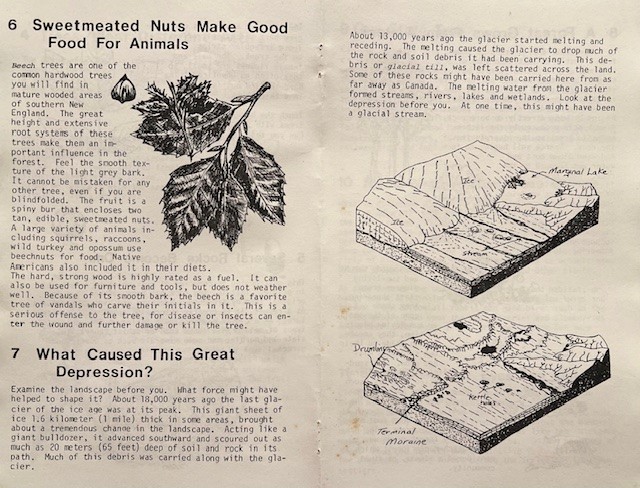
The following photos show the pages from the old Witches Hollow Nature Trail booklet.




Questions? Email me at naturenerdsramble@gmail.com or find me on Instagram @the_real_nature_renee.
Subscribe to Trail Talk
your next adventure awaits
 Subscribe to Trail Talk